
Close
Dr. Otokunor Commends Afaani Royal Enterprise as Dobidi Initiative Records Progress in Wungu
28Sep’26
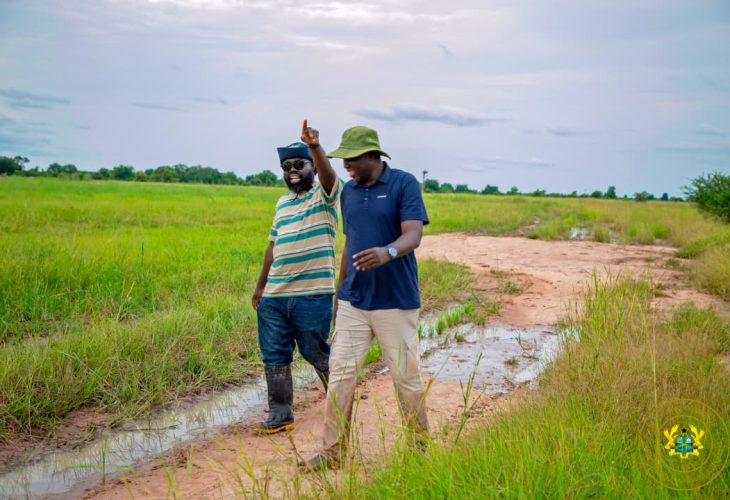
WUNGU, North East Region — The Director of the Presidential Initiatives in Agriculture and Agribusiness (PIAA), Dr. Peter Boamah Otokunor, has commended Afaani Royal Enterprise for its contribution to rice production and the implementation of the DOBIDI Initiative at Wungu in the West Mamprusi area of the North East Region.
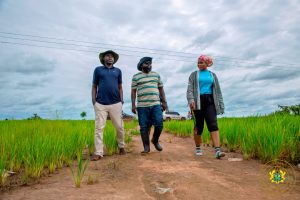
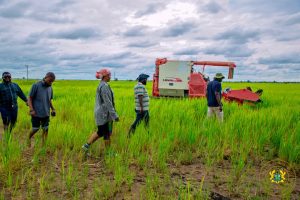
Dr. Otokunor made the remarks during a working visit to the company’s farming operations to assess progress under the DOBIDI Initiative, an integrated outgrower scheme designed to support smallholder farmers with inputs, technical assistance, land preparation, harvesting and market linkages. The initiative is being implemented to address some of the major constraints facing smallholder farmers and improve agricultural productivity.
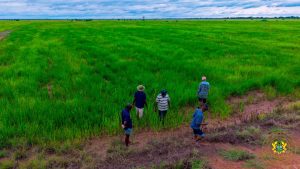
Afaani Royal Enterprise currently cultivates more than 1,000 acres of rice, with the operation serving as an important component of efforts to expand local rice production and strengthen linkages between farmers and agribusiness operators.
Dr. Otokunor expressed satisfaction with the progress made by the enterprise and praised its commitment to commercial agriculture and farmer support.
“We commend Afaani Royal Enterprise for the work they are doing. This is exactly the kind of partnership and investment we need to expand production, improve the incomes of farmers and strengthen Ghana’s agricultural sector,” he said.
He said the current production cycle was progressing towards harvesting, with harvesting expected to commence by October. He added that arrangements were also being made to ensure the availability of a market for the produce when it was harvested.
According to Dr. Otokunor, the gap between Ghana’s rice demand and domestic production remains significant. He said Ghana consumes approximately 1.4 million metric tonnes of rice while local production is around 750,000 metric tonnes, creating a substantial supply gap that must be addressed through increased domestic production.
“Our demand is more than what we currently produce. We must therefore increase production and create the conditions for farmers to produce more, sell their produce profitably and reduce our dependence on imports,” he said.
Dr. Otokunor explained that the DOBIDI Initiative was designed not only to provide production support but also to improve the profitability of farming by reducing some of the major costs and risks confronting smallholder farmers.
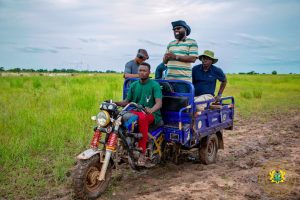
He said the initiative’s support for land preparation, inputs, technical services and harvesting would help farmers improve productivity while maximizing their profit margins.
“We want to maximize the profit margin of our farmers. When farmers have access to the right inputs, land preparation, harvesting support and a ready market, they are in a much better position to make agriculture a profitable business,” he said.
The PIAA Director stressed that Ghana’s agricultural transformation must ultimately lead to food security, adding that the country could not continue to depend heavily on external sources for food commodities that could be produced locally.
“Ghana must be food secure,” Dr. Otokunor said, emphasizing the need for increased investment, stronger private-sector participation and sustained support for farmers.
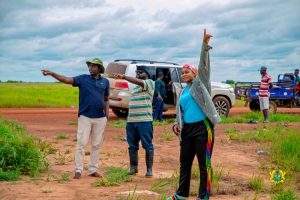
The DOBIDI Initiative is being implemented as a government-led, private-sector-driven programme with emphasis on supporting smallholder farmers, improving access to inputs and finance, providing technical services and strengthening market and post-harvest linkages.
The working visit to Wungu forms part of continued field-level engagement by PIAA to monitor implementation, assess progress and strengthen collaboration with private-sector partners involved in the government’s agricultural initiatives.

Leave Your Comment