
Close
Government Distributes 20,000 PPE Sets to Women Shea Collectors at World Shea Expo 2025
15Sep’25
The government of Ghana has donated over 20,000 sets of personal protective equipment (PPEs) to women cooperatives and shea nut collectors across Ghana’s five northern regions, in a bold move to enhance safety, productivity, and dignity in one of the country’s most important export-driven industries.
The presentation took place at the Modern City Hotel in Tamale, during the opening ceremony of the World Shea Expo 2025, where the keynote address was delivered by Dr. Peter Boamah Otokunor, Director of Presidential Initiatives in Agriculture and Agribusiness at the Office of the President.
“The PPE distribution is therefore seen as a ground-breaking intervention to protect livelihoods, promote decent working conditions, and improve efficiency in an industry that contributes significantly to Ghana’s non-traditional exports,” he said

Dr. Otokunor, in his address, emphasized that the shea industry is not just about exports, but about empowering women and youth to secure meaningful economic returns from their labour.
“This gesture is more than a donation; it is a signal of the government’s commitment to protecting the women and young people whose sweat and resilience sustain this industry. If we empower them with safety, skills, and access to finance, we can transform shea into a billion-dollar driver of inclusive growth,” he said.
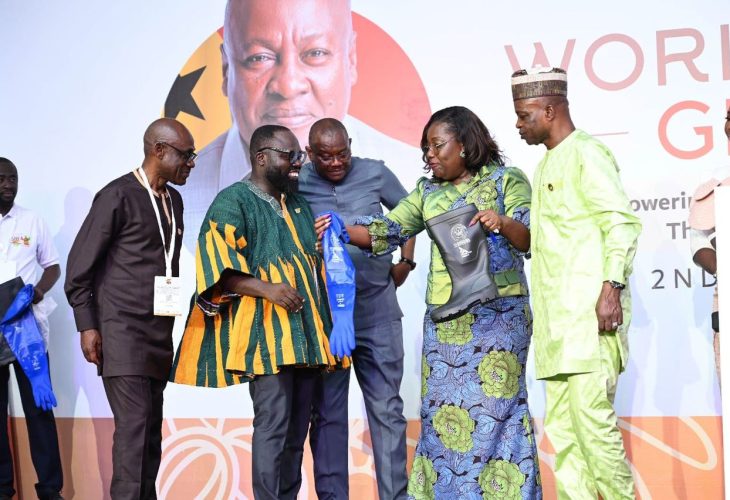
On behalf of President John Dramani Mahama, the Deputy Chief of Staff, Nana Oye Bampoe Addo, led the symbolic presentation of the PPEs. She was joined by CEOs of key partner institutions, including the Ghana Export Promotion Authority (GEPA), Ghana EXIM Bank, Tree Crop Development Authority (TCDA), and the Ghana Enterprises Agency (GEA).
The gesture was made possible through the collaboration of the Ghana Export Promotion Authority, Ghana EXIM Bank, and the Directorate for Presidential Initiatives in Agriculture and Agribusiness, which jointly financed the procurement and delivery of the PPEs.
The PPE distribution is expected to directly benefit thousands of women in northern Ghana, significantly reducing occupational hazards while increasing productivity.

Leave Your Comment